
Check out this great video of EARS volunteers and UAN Emergency Services Manager Janell Matthies at the emergency horse shelter in Tennessee. The horses are sure looking healthier and happier!
Saturday, December 12, 2009


Thursday, December 10, 2009
Kind words of thanks
Today we received a wonderful note from Terri Merritts of Nashville thanking UAN and the EARS volunteers for helping the horses in Tennessee. Here is part of Terri's note:

I wanted to tell you how much my family appreciates the help you are giving to those sweet horses and dogs at the Tennessee Fairgrounds. I am a longtime dog trainer who works with rescues/abused animals and have worked with horses my whole life as well. My mom used to tease me that I was born on a horse! We've seen a lot of dog, cat, and horse abuse over the years. I saw the photos of the horses and hate to admit that I have seen even worse. What kind of people think it is okay to do this?

Thank you so much for the love and care you are giving these precious animals and let us know if we can help. My husband lost his job a year ago and we use this time to work on animal rescue. I just went to your Web site and signed up for your e-mail newsletters and became a fan on Facebook and followed you on Twitter. You are making a real difference in the world and being a voice for the innocent animals who are suffering. I'm just so glad there are people in the world like you who really do care for those who cannot protect themselves.
Wednesday, December 9, 2009
Horses are on the move

Good news! Fifteen of the healthiest horses at the emergency shelter have been transported to Horse Haven of Tennessee, an equine humane society in Knoxville.
It will still be a while before the horses are available for adoption, but we're thrilled that these horses were deemed healthy enough to travel. Among the 15 horses transported were one mare and her foal.

Read more in this Nashville Tennessean article.
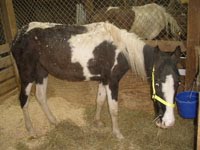
Also, pictured here are a few horses who were able to venture out of the emergency shelter and enjoy some fresh air earlier this week.
Tuesday, December 8, 2009
Horse rescue goes to the dogs

The 84 horses UAN's Emergency Animal Rescue Service (EARS) volunteers are sheltering in Nashville now have company -- 17 starving dogs rescued from a squalid trailer in East Tennessee.
The dogs are mostly 35- to 50-pound terrier and chow mixes. They were emaciated with matted fur, parasites and open wounds. The trailer had no water or electricity and was filled with feces and urine. Neighbors reported that the property owners had moved away, leaving the dogs behind with no food or water.

The Grainger County Sheriff's Department and the Grainger County Humane Society asked The Humane Society of the United States (HSUS), which also led the rescue of the 84 horses, to remove the dogs. The rescued dogs will be cared for by The HSUS and United Animal Nations until their custody is determined.
Thursday, December 3, 2009
Angels in red shirts
Submitted by UAN Communications Director Alexis Raymond
This week I spoke to several EARS volunteers who have returned from the emergency horse shelter in Tennessee about their experience. The only thing I can say is, “Wow.” United Animal Nations is lucky to have so many amazing, kind and dedicated people on its EARS team.

Melissa Richards (pictured at right) helps animals every day as the president of the board of directors of New Leash on Life in Lebanon, Tennessee. She is a member of her local Disaster Animal Response Team and has rescued animals from puppy mills and a tornado that hit Tennessee a few years ago.
Melissa deployed to the emergency horse shelter in Nashville from November 24 to 28, where she said she spent most of her time “scooping poop – seriously!”

“It was one of the best Thanksgivings I ever had,” Melissa said. “I couldn’t have sat home eating and watching television knowing that the horses needed help. I would do it every Thanksgiving.”
Melissa said that in her four days at the shelter, she literally saw the starving horses “fatten up” and become less fearful. “Their ribs were showing less by the time I left,” she said. “They were terrified the first day, but by the last day I was getting kisses and hugs from them.”

Nicole Tipton worked so hard in Tennessee that she had to see her chiropractor for an adjustment when she returned home to Georgia. Nicole said she did “anything that was needed” during her deployment – including mucking stalls, filling water buckets and lifting horses (like Longshot, pictured at right) who had fallen.
“Even though they were malnourished and 400 pounds underweight, they still weigh a lot and it took six to eight of us to pick them back up,” Nicole said.
Despite the physically demanding work she did, Nicole said the experience was rewarding – so much so that she is returning this weekend.
“It was wonderful knowing that the animals didn’t have to suffer anymore, and I was part of that,” she said. “Some of them were on the verge of dying had they not been rescued … it felt great to be able to show them love and kindness.”

Karen Little is a librarian at the University of Louisville and brought some of her organizational skills to work at the emergency shelter, helping the veterinarians take records on the horses and keep them organized.
“It is critical that those records be kept well, and if that is the best way I can help, I am thrilled to do it,” Karen said.
Karen has been helping animals in her own community for years – 16,000 animals to be exact. Ten years ago she and her husbanded founded the nonprofit organization Alley Cats Advocates, which has 120 volunteers who care for feral cats through the Trap-Neuter-Return method.
Karen trained to be an EARS volunteer in the mid-1990s and deployed to UAN’s Hurricane Katrina response in Monroe, Louisiana in 2005. She said her experience in Tennessee was "life changing."

“It is always interesting to be among a set of people who are going to do whatever they need to do to help an animal, even if they don’t know that animal,” Karen said.
I couldn't have described the EARS volunteer team more accurately myself.
Tuesday, December 1, 2009
Giving up is not an option
Our EARS team in Tennessee is working practically around the clock to care for 84 sick and starving horses who were rescued from lives of neglect last Tuesday. The volunteers barely have time to sleep, let alone take photos or write blog posts. But we did just speak with UAN Emergency Services Manager Janell Matthies, who told us about a few of the many wonderful horses who are fighting for their lives.

The most critical case from the rescue was a two-day-old foal who had never eaten. His mom was so malnourished, she was never able to produce milk. She had a body score of about 1.5 on the Henneke Scoring System. The baby was very weak and in critical condition. If he had been out there another 24 hours he wouldn’t have made it. (Photo at right courtesy The HSUS)
An EARS volunteer spent an entire day trying to get the foal to drink milk from a bottle or bowl. He wouldn’t do it. Janell and this volunteer stayed up all night, then finally at 4 a.m. the foal took a bottle. Then, he discovered a bowl and, as Janell put it, "started eating like a pig." During the day a volunteer was on “foal duty” and fed him every two hours. For five nights, Janell stayed with the foal all night so she could feed him every two hours.
Janell said that during the rescue mission, the mom was doing everything possible to keep the rescuers away from the baby. "When we were trying to feed the baby, she was charging us in the stalls and wouldn’t let us near her," Janell said.

But by night two, when the baby was eating a lot, mom's attitude changed. While Janell was kneeling and holding the bowl for the baby to drink, Mom was kneeling down right by her side.
“She started licking my head,” Janell said. "Then she would nudge baby toward me and keep her nose right next to the bowl while he ate. Within 24 hours the mom went from trying to hurt us to bringing her baby over to us to eat. Some people say the animals know we are trying to help them – this is absolute proof.”
The foal who was so limp and lifeless that he had to be carried into the temporary shelter last week is now frolicking and playing. Janell said he’s been named Forrest because "all he wants to do is run."

Still standing
Another problem prevalent at that emergency shelter is colic, abdominal problems that cause the horses to lie down. The owner of the horses fed them all sweet feed right before the rescue, which is causing many of them to colic. But because the horses are so weak, many of them cannot get back up again once they are down. When a horse goes down at the shelter, at least six people have to physically hoist him or her up because lying down for too long can cause organ damage or even death.
Janell said many of the horses won't even try to get back up. "They’ve completely given up," she said. "But we watch them constantly ... we don’t care if that horse has given up, we are going to get him up and hold him up. We are not giving up on them."

Long Shot (pictured at right) is one mare who has given up, Janell said. But she is young and she is healthy, and nobody is going to let her stay down … they are not going to let her give up.
"The volunteers all feel the same way, they don’t want to leave at the end of the night," Janell said. "Even on Thanksgiving, I told them to go get some dinner, but they all wanted to stay. They wanted to spend their Thanksgiving here with the horses."

A retired military officer stopped by the emergency shelter the other day to offer help. He recently returned from Iraq and is in the local volunteer fire department. He and some of his fellow firefighters are now helping the volunteers hoist the fallen horses back up, as well as stacking and organizing the overwhelming loads of hay that are being donated. (Photo at right courtesy The HSUS)
Feeding Frenzy Janell reported that the horses eat 24 hours a day because they are so starved. The volunteers are keeping "hay under their noses all the times." Each horse eats between one to three bales of hay per day. That is a lot. They all came into the emergency shelter scared and completely unsocialized. They would stay at the back of the stall. Now, they hang their heads over the edge of the stall looking at the volunteers, wondering where their hay is. They start making noises in the morning and kicking the boards.

"We’re seeing a lot more activity and sassiness come out," Janell said. "Stallions are starting to act like stallions. When they run out of hay, they are beginning to make a fuss."

The horses are starting to get names. Volunteers named one Tease (pictured at right with Janell) because she keeps going down and staying down. "There is nothing wrong with her," Janell said. "She just likes it when we all come in and make a big fuss."
Eventually the horses will be made available for adoption. But right now they are not strong or healthy enough to be transported anywhere.
"We will go to whatever extent it takes so they get what they need to live a happy and healthy life," Janell said. "We’re going to give them what they never had before."
If you would like to support our mission to help the horses, you can make a donation to our Disaster Relief Fund.
Monday, November 30, 2009
A fighting chance
 An update from UAN Emergency Services Manager Janell Matthies:
We are still fighting 24 hours a day to keep these horses alive. Some of them have given up, but we haven’t. I’m hoping to get some sleep tonight, pending no emergencies. Still unloading truckfull after truckfull of hay, utterly exhausting physically to add to the emotional exhaustion, but it’s been incredibly rewarding that everyone is still alive. We got some reinforcements today and hoping for more the rest of the week. More details will come as I slowly start to catch up...

Subscribe to:
Posts (Atom)